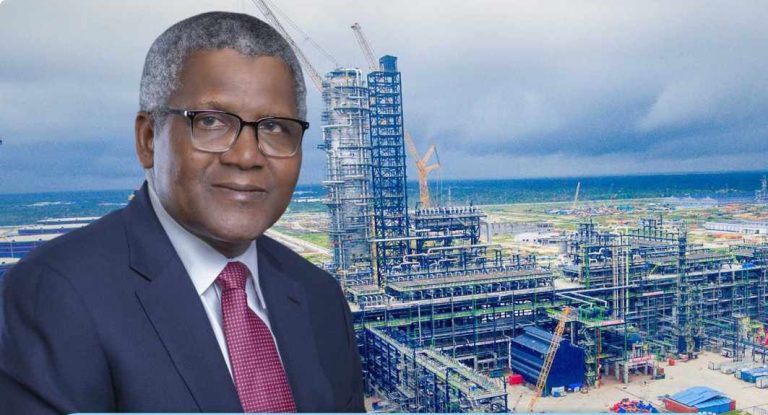
The fact that you can buy the shares for just ₦5,250 does not mean they are cheap.
The offer opens on 14 September and closes on 13 October 2026. Dangote Refinery is offering up to 4.1 billion new shares at ₦525 each, with a minimum application of 10 shares.
If fully subscribed, the IPO will raise about ₦2.15 trillion, with roughly ₦2.11 trillion remaining after costs.
The new shares represent about 3.3% of the enlarged company. After the IPO, Dangote-related interests are expected to retain roughly 84–89%.
At ₦525 per share, the refinery has an implied value of about ₦65.22 trillion.
So the important question is not simply:
“Can I afford ₦5,250?”
It is:
“Is ₦525 a reasonable price for what this company could become?”
Forget the Amazon comparison
Aliko Dangote has compared the opportunity to Amazon, pointing to the fortunes made by people who bought Amazon early and held for years.
Amazon's 1997 IPO price was $18, and long-term shareholders who stayed with the company through its huge expansion made substantial returns. Jeff Bezos owned roughly 42–43% after the IPO.
But investors should not take the comparison too literally.
Amazon's ownership changed significantly over the years through further share issuance, employee options and Bezos selling shares.
Dangote Refinery is starting from a very different position, with Dangote-related interests expected to retain around 84–89% after the IPO.
The useful lesson from Amazon is simpler:
A great business can become a great investment if its earnings grow strongly and you do not pay too much for that growth.
What are you actually betting on?
Dangote Refinery has tested and operated at levels approaching 700,000 barrels per day, although its commonly cited nameplate capacity is around 650,000 bpd.
The company plans to expand to 1.4 million barrels per day by 2029, at an estimated cost of about $14.3 billion.
The IPO will provide only around 10–11% of that amount.
The rest will have to come from the company's operations, borrowing or other sources of funding.
So investors are not just buying today's refinery.
They are also betting that the company can successfully execute a much larger expansion.
The business is already making money
This is not simply a bet on the future.
After recording a loss in 2025, Dangote Refinery reported about $1.82 billion in profit after tax in the first half of 2026.
Utilisation has also improved, and the refinery has become an important supplier to Nigeria's fuel market.
Those are significant developments.
But refining is cyclical. One strong six-month period does not tell us how the business will perform through an entire refining cycle.
Future earnings will depend on factors including crude costs, fuel prices, demand and global refining margins.
So, is ₦525 expensive?
There is no clear consensus that ₦525 is either cheap or expensive.
Some Nigerian research houses have valued the company above ₦525 per share.
At the same time, comparisons with established international refiners suggest investors may be paying a relatively high valuation.
Turkey's Tüpraş, for example, has traded at lower headline valuations. But it is not a perfect comparison because it operates in a different market, with a different cost structure, tax system, regulatory environment and operating history.
So Tüpraş is one reference point, not proof that Dangote Refinery is overpriced.
The IPO price ultimately depends on what investors believe the refinery can earn as it grows.
The IPO lesson many investors miss
Getting shares at the IPO price does not guarantee that you will make money immediately after listing.
Some IPOs have fallen sharply after listing as early investors, founders or employees became able to sell their shares.
Facebook is a famous example.
Its 2012 IPO was priced at $38. Within months, the stock had fallen well below that level. When an early lock-up expired in August, about 271 million additional shares became eligible for sale, and Facebook fell about 6.2% that day, closing at $19.87.
The lesson is not that Dangote Refinery will behave like Facebook.
It is that the supply of shares available in the market can change after an IPO.
Even SpaceX is a warning
A more recent example is Elon Musk's SpaceX.
SpaceX priced its IPO at $135 per share in June 2026. The stock initially surged, reaching an intraday high of about $225.64 just days after listing.
But the excitement did not last.
By July, SpaceX had fallen below its $135 IPO price, eventually closing at $131.11 — meaning investors who bought at the IPO price were already sitting on a loss.
It is a useful reminder for Dangote Refinery investors:
A famous company, a strong story and huge investor excitement do not guarantee that the IPO price will hold after listing.
The lesson is simple: don't confuse IPO excitement with guaranteed returns.
Dangote Refinery could perform very differently from SpaceX, but its shares will also have to find their own market price once trading begins on the NGX.
If large shareholders from private placement eventually decide to sell significant amounts, the additional supply could put pressure on the share price.
So don't assume that ₦525 is necessarily the cheapest price you will ever see.
Be very careful if...
You are borrowing money to invest.
You may need the money soon.
Your main reason is simply “it's Dangote.”
You are buying because everyone else is buying.
You think, “It's only ₦5,250.”
Or you already have significant exposure to Nigerian stocks, energy companies or Dangote-related businesses.
The low minimum makes the IPO easy to participate in.
Easy to buy does not mean cheap.
Should you buy?
The investment case becomes stronger if you believe Dangote Refinery can:
- Maintain strong earnings through different refining cycles.
- Secure reliable crude supplies.
- Successfully expand towards 1.4 million barrels per day.
- Generate enough cash to support that expansion without creating excessive financial pressure.
If those things happen, ₦525 could prove to be a good long-term entry price.
But investors should also recognise that the valuation already reflects expectations of substantial future growth.
You can also wait until after the listing.
Once the shares begin trading on the NGX, you will have a market price, trading history, liquidity data and eventually more public-company results to assess.
That does not guarantee a lower price. It simply gives you more information.
Bottom line
Dangote Refinery is neither an obvious bargain nor an obvious trap.
It is a bet on whether the company can turn its enormous refining capacity, strong recent earnings and planned expansion into sustained long-term profits.
The important question is not whether Dangote Refinery can become a giant.
It is whether ₦525 gives you enough potential return for the risks you are taking to get there.


.jpg)