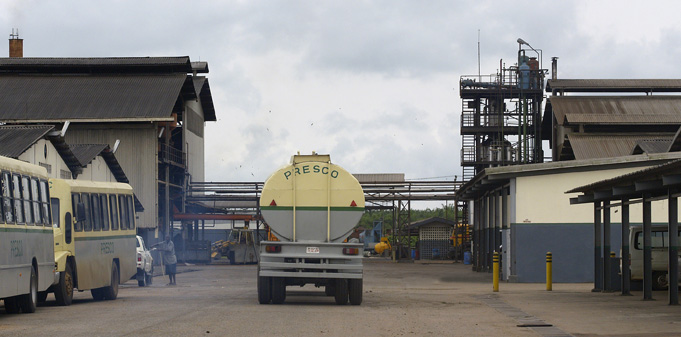
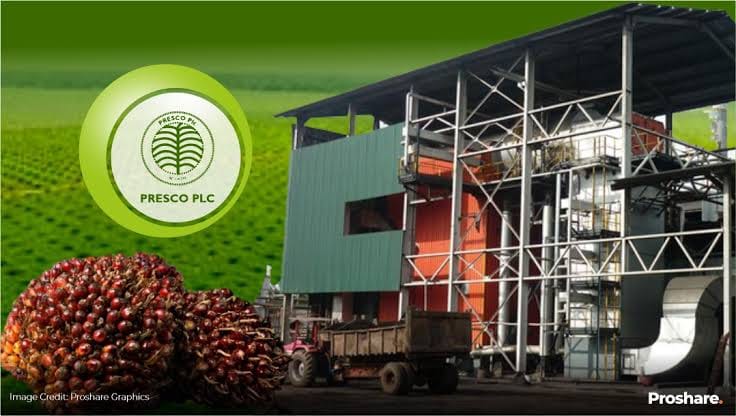
Presco Plc, the NGX-listed palm oil producer majority-owned by Belgium's Siat Group, has filed unaudited results for the six months ended 30 June 2026, showing a company that dramatically strengthened its balance sheet even as profitability metrics softened.
Revenue & Profit Trends
Group revenue was essentially flat at ₦198.75bn versus ₦198.74bn a year earlier — but the flat headline masks a slowdown: Q2 2026 revenue alone fell 6.7% y/y (₦97.9bn vs ₦104.9bn), with growth concentrated in Q1. Net profit fell 7.3% to ₦82.3bn (from ₦88.7bn), and Q2 net profit dropped nearly 20% y/y. Negative — the deceleration into Q2 suggests softer pricing or volumes, not just tough comps.
Margins & Cost Structure
Gross margin slipped to 83.4% from 84.3% as cost of sales rose 5.5% against flat revenue. Administrative expenses jumped 13.3% and selling/distribution costs surged 75%, partly on logistics and travel costs. The real profit-eroding factor, though, was tax: the effective tax rate spiked to 32.7% from 20.7%, likely reflecting Nigeria's new education tax and levy changes. Operating profit before finance costs fell 2.6%. Negative — cost inflation plus a heavier tax burden outpaced revenue growth.
Balance Sheet Strength
This is the standout story. Presco used its large cash pile to slash borrowings from ₦317.3bn to ₦119.5bn — a 62% reduction — flipping the company from net debt (~₦55bn at end-2025) to a net cash position of roughly ₦9bn. Finance costs fell 32% as a result. Cash fell from ₦262.6bn to ₦129.9bn to fund the repayment, and total liabilities nearly halved (₦483bn to ₦278bn). Equity rose 13.7% to ₦503.6bn. Positive — a materially de-risked balance sheet, though at the cost of a much thinner cash buffer.
Period-on-Period Comparison
Versus H1 2025, revenue was flat, profit before tax rose 9.3% (aided by lower finance costs and higher finance income), but net profit and EPS fell because of the tax spike. Basic EPS dropped 20.5% to ₦70.52 from ₦88.72 — a decline steeper than the profit fall, since shares outstanding grew 16.7% following a rights issue. Mixed — pre-tax operating trends improved, but shareholders felt a bigger hit at the EPS line.
Red Flags & Strengths
-
Red flag: Q2 revenue and profit both declined y/y — a trend worth watching into Q3.
-
Red flag: Effective tax rate near-doubled, a structural headwind if sustained.
-
Strength: Aggressive deleveraging and a swing to net cash is a rare, high-quality balance sheet move in Nigeria's high-rate environment.
-
Strength: Board declared an interim dividend of ₦10/share, signalling confidence.
Valuation Implications
The share price has surged to ₦2,300 (from ₦1,450 at end-2025), up ~59%. Annualising H1 EPS of ₦70.52 implies a trailing P/E near 16x — not cheap for a slowing top line, suggesting the market is pricing in balance-sheet quality and dividend visibility rather than near-term earnings momentum.
Top 5 Investor Takeaways
-
Revenue is flat for H1 but decelerating quarter-on-quarter — Q2 was weak.
-
Net profit and EPS fell, driven mainly by a sharply higher tax rate, not operating weakness.
-
The balance sheet transformation — from net debt to net cash — is the single biggest positive in this filing.
-
Rising admin/selling costs and margin compression bear watching.
-
Share price has already re-rated significantly, raising the bar for continued outperformance.
Overall Verdict: Neutral
Strong deleveraging is offset by softening quarterly revenue, margin pressure, and a materially higher tax bill.
Trajectory Signal
Presco looks like a company prioritizing balance sheet resilience over near-term earnings growth — a defensible strategy given Nigeria's high-rate environment, but one that puts more pressure on H2 volumes and pricing to justify the current valuation.
Caution on Single-Quarter Read
Palm oil is a seasonal, commodity-linked business with FX and biological-asset revaluation swings; one half-year print shouldn't be extrapolated without checking full-year seasonality, weather/yield factors, and global CPO price trends.

.jpg)